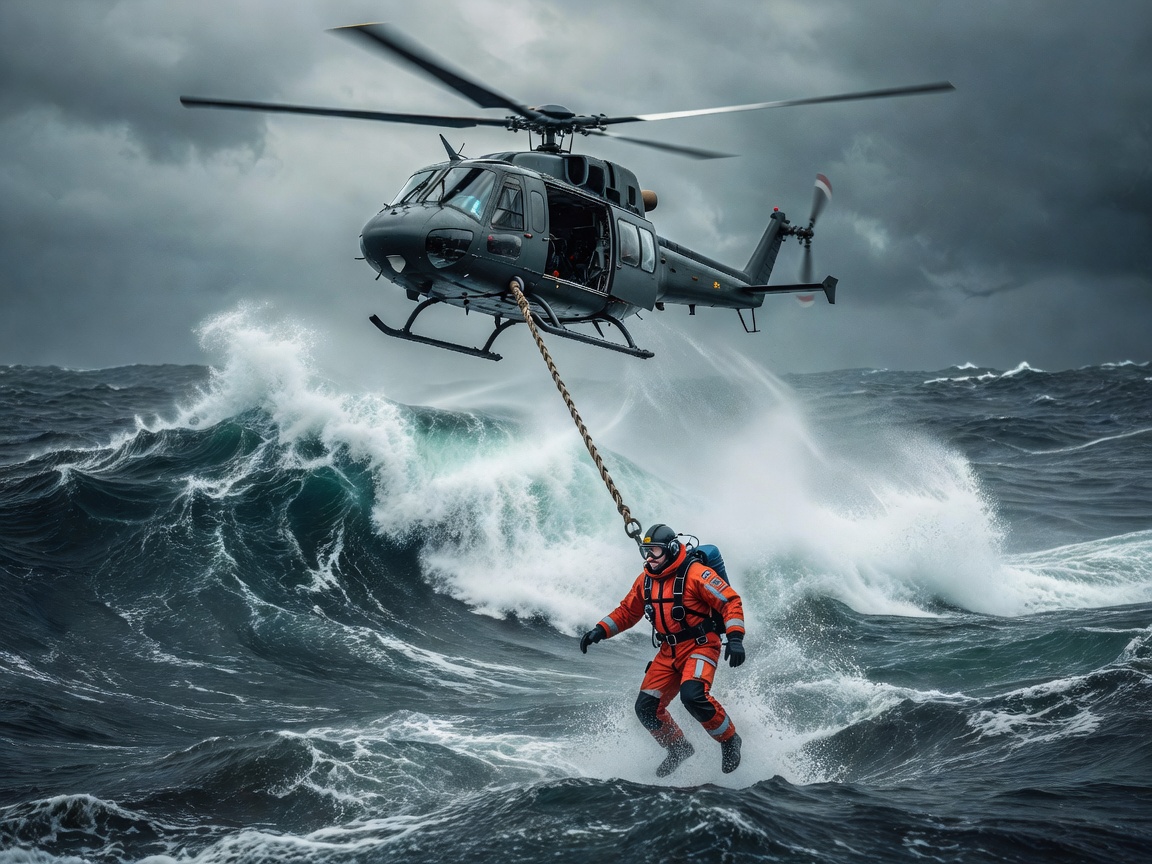
Search and Rescue (SAR) is arguably the most demanding operational profile for any helicopter crew. It requires flying into the exact severe weather conditions that ground other aircraft, executing pinpoint maneuvers near hazardous terrain, and doing so while managing complex crew coordination.
The SAR Operating Environment
Helicopters excel in SAR because they can hoist survivors from environments where landing is impossible. However, holding a steady hover requires intense pilot concentration and aircraft power.
- Maritime Rescue: Hovering over open water, particularly at night or in heavy storms, poses a severe risk of spatial disorientation. Pilots lack stationary visual reference points, as the water below is moving. Modern SAR helicopters utilize automatic hover-hold functions integrated into their autopilots to mitigate this risk.
- Alpine Rescue: High-altitude mountain rescues push helicopters to their aerodynamic limits. The thin air reduces both engine performance and main rotor lift generation. Furthermore, unpredictable downdrafts near cliff faces require immediate and aggressive control inputs.
Hoist Mechanics
The external rescue hoist is the defining tool of a SAR helicopter. These electrically or hydraulically powered winches are mounted to the airframe above the cabin door. They are capable of lifting hundreds of pounds using a highly engineered steel or synthetic cable.
Operating the hoist is the responsibility of the hoist operator or crew chief. This individual leans out of the aircraft door, guiding the rescue swimmer down to the victim. Because the pilot often cannot see directly below the aircraft during a hover, the hoist operator gives constant verbal commands ("forward five, hold, down two") to position the helicopter precisely over the target.
Specialized SAR Avionics
Locating a target in expansive oceans or dense forests relies on advanced sensor suites.
Forward-Looking Infrared (FLIR) is paramount, allowing crews to detect the heat signature of a person against a cold background. Weather and search radars help crews navigate around dangerous storm cells and identify small surface targets, like a life raft, in the open ocean. Furthermore, radio direction finders can lock onto the signal emitted by distress beacons, drawing a direct line on the navigation display to the individuals in need of rescue.
Crew Resource Management (CRM)
Due to the high-stakes, low-margin-for-error nature of the mission, SAR units employ rigorous Crew Resource Management. This ensures that the pilot, co-pilot, flight mechanic, and rescue swimmer all communicate clearly, cross-check each other's actions, and speak up if a situation exceeds acceptable safety margins. A successful rescue is a triumph of teamwork over a hostile environment.