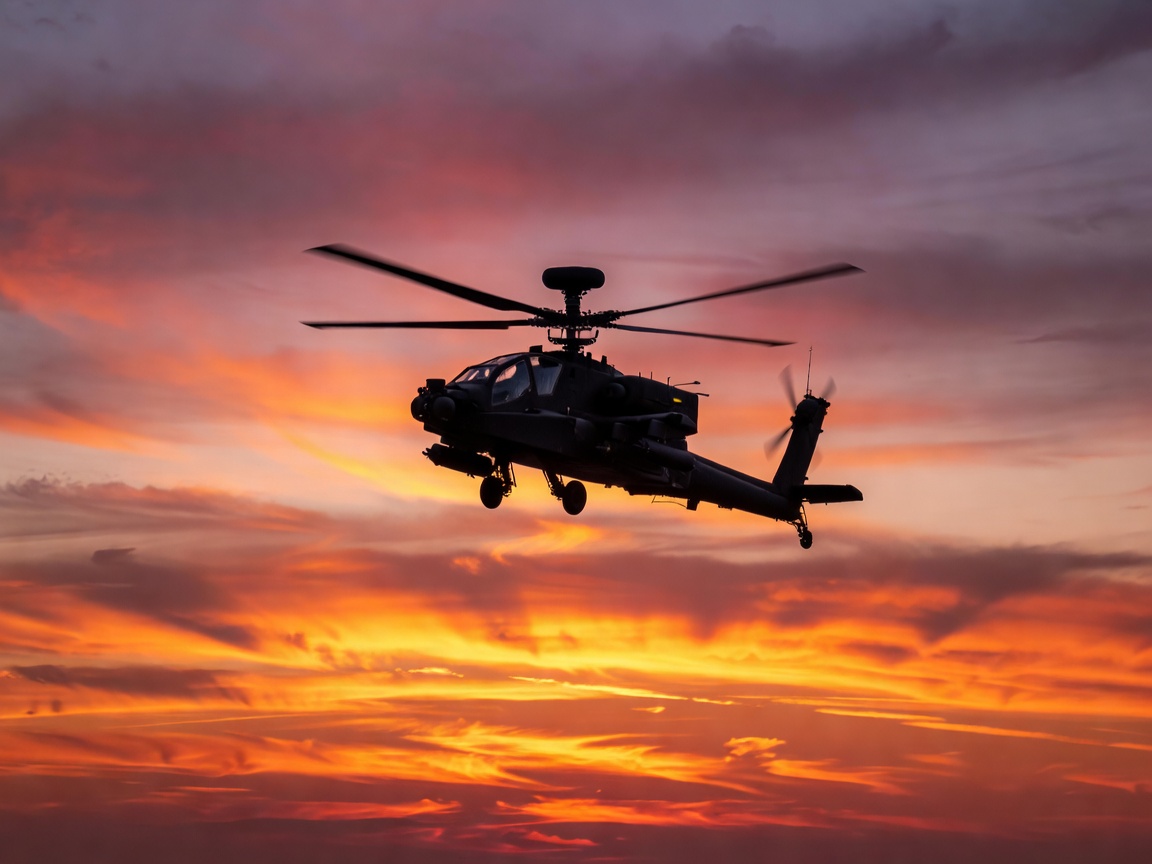
Military rotary-wing aviation forms the backbone of tactical maneuverability for modern armed forces. Unlike civilian aircraft designed primarily for economy, military helicopters are designed for survivability. They feature redundant hydraulic and electrical systems, crash-resistant fuel cells, and armor plating around critical components and the cockpit.
Attack Helicopters
The primary role of the attack helicopter is anti-armor and close air support. Characterized by a narrow tandem-seat cockpit—which reduces the frontal profile presented to enemy fire—these machines are flying weapons platforms.
Key systems on attack helicopters include mast-mounted or nose-mounted sighting systems that incorporate daytime television, thermal imaging, and laser rangefinders. These sensors allow the crew to designate targets for guided munitions. Their armament typically comprises a chin-mounted automatic chain gun, unguided rockets, and precision air-to-ground missiles.
Utility and Multi-Role Transport
Utility helicopters are the true workhorses of the military. Their spacious cargo cabins allow them to perform a vast array of missions: troop insertion and extraction, medevac, resupply, and airborne command and control.
The flexibility of utility helicopters means they can be rapidly reconfigured. A cabin that holds a dozen combat-equipped infantrymen in the morning can be stripped and fitted with medical litters by the afternoon. To survive in contested airspace, utility helicopters are often fitted with radar warning receivers, infrared jammers, and chaff/flare dispensers to counter surface-to-air threats.
Heavy Lift and Cargo
When the logistical requirement exceeds the capacity of utility helicopters, heavy-lift platforms take over. Characterized by massive tandem-rotor or enormous single-main-rotor designs, these aircraft can move artillery pieces, light armored vehicles, and large fuel blivets directly to the front line.
The power generated by heavy-lift engines requires monumental transmission systems to handle the immense torque. Moving heavy external loads via dual-point sling systems provides stability at speed, allowing these giants to fly faster and safer with external cargo than older single-point systems.
Anti-Submarine Warfare (ASW)
Naval forces rely on specialized maritime helicopters to extend the sensory reach of their fleets. Operating from the decks of destroyers and frigates, ASW helicopters use dipping sonar—a sensory package lowered into the sea via cable while the helicopter hovers—and droppable sonobuoys to detect, track, and potentially engage hostile submarines using lightweight torpedoes.
Naval helicopters face unique operational hazards. They must endure highly corrosive saltwater environments, necessitating intensive anti-corrosion treatments, and their rotor blades and tail booms must fold to fit into compact shipboard hangars.